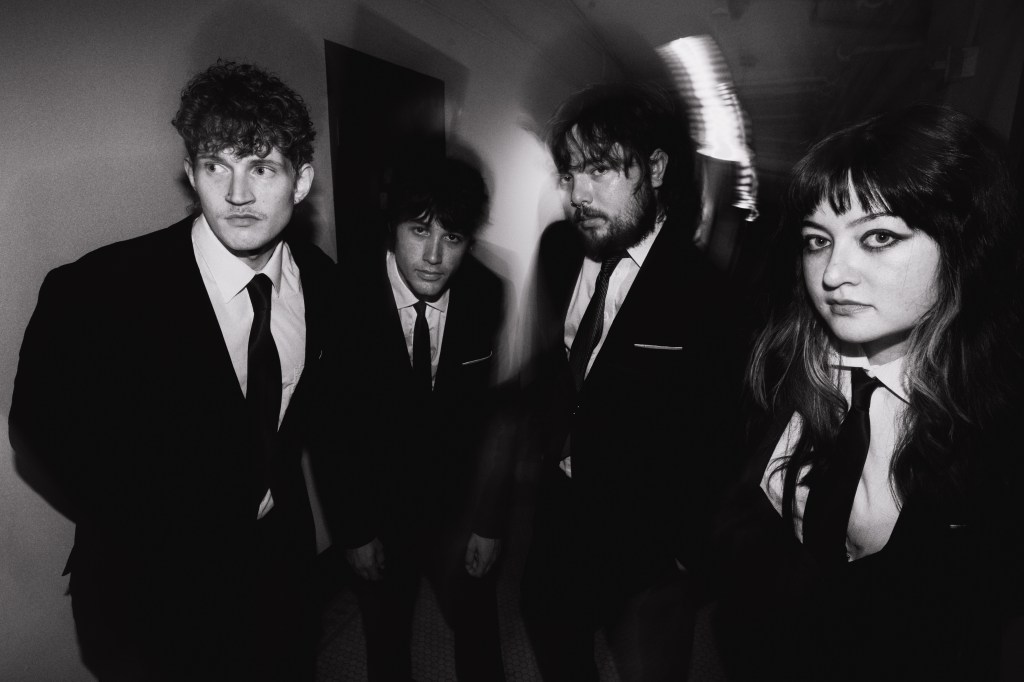
Couch Dog may be returning with new members and a new sound, but they bring the same love and passion for their music and the people around them that they’ve carried since the beginning. The Los Angeles indie/garage rock four-piece — consisting of Max Ferrer on vocals and rhythm guitar, Pablo Acosta on lead guitar, Tasha Lee on bass, and Liam Reece on drums— released their latest single, “Rod Sterling,” on October 20, introducing fans to a new side of the band.
In a conversation with Acosta, The Underground Edit discussed the inspiration behind “Rod Sterling,” the band’s evolving sound, and what fans can expect from Couch Dog’s next chapter.
Can you tell me the story behind “Rod Sterling”? What inspired the song, and how did it come together?
Acosta: After our move to the city of LA, and with what was, at the time, the new inclusion of our new drummer Liam Reece, we were incredibly excited to start writing some new music. “Rod Sterling” started as us jamming on a couple of heavily distorted chords and a desire to write a snappy track. At the time of its inception (around mid 2025), we were heavily inspired by lo-fi garage punk and seeking to enter new territory lyrically.
After coming up with the first half and exploring an explosive sense of uncertainty in the face of the unknown, we started jamming on a slower outro, which to us signified a sense of letting go/accepting that unknown. It was an uncertain, exciting, and busy time, with tons of new feelings and a wide-open sound palette for us to pick from. Some of these feelings we’ve been working into the music also pop up in the music video, which we’re very excited about.
There’s also an obvious nod to Rod Serling, who is someone we look up to in his approach to digging into the abyss—the man was a WWII veteran, anti-fascist, and proto-punk in essence (they called him the “angry young man” of Hollywood).
“Rod Sterling” explores a different sound than some of your previous work. What inspired this shift in genre, and was it something you had been wanting to experiment with for a while?
Acosta: We’ve always had a lot of admiration for and personal enjoyment in heavier music, and our live shows are a huge indicator of that part of us—and they have been since day one. When we worked on How To Ruin Your Life Fast, we had gone into it with the intention of creating an experience for our fans that differed from our live shows. Most of our listener base had only heard the lo-fi recordings of Bad and Better Than Ever and a handful of heavily energetic shows. We perform most of the tracks on How To Ruin Your Life Fast faster and with more of an edge than they are on the record – and that’s by design.
On “Rod Sterling,” we wanted to bring back that energy we feel at live shows, while also just writing a punkier, heavier track to go along with that performance. In regard to the second half of the song, we have always been fans of push-and-pull dynamics in our music and others’ music, so we thought it’d be fun to incorporate that here. We also found that closing the song this way was an exciting avenue for us to explore the more abstract topics instrumentally, and expand on them.
You’ve described Couch Dog’s music as being made for “dancing, crying, and kissing.” How do those different emotions influence your songwriting?
Acosta: “MUSIC FOR DANCING, CRYING, AND KISSING” has been our motto since the beginning. We want our listeners to feel free to explore these emotions while listening to our music since they’re fundamental to the human experience. Dancing, sadness, love.
Couch Dog performing or sharing a new song is our invitation for the listener to dance, cry, express their love to those closest, and to join the mosh pit. The mosh pit historically is a circle of resistance, a place where visceral release of emotions can occur, somewhere where the listener can find community and process these emotions in dance and playful physical participation—of course, all while keeping it respectful and looking out for one another. We’re incredibly grateful that our project has brought so many people together in a community where this can happen.
“Rod Sterling” serves as an introduction to your upcoming sophomore album. What can you tell us about the creative direction of the new record, and how does this single fit into the bigger picture?
Acosta: “Rod Sterling” plunges us into the new sonic territory of our next LP, exploring grunge, garage, and punk genres, with a darker sound palette. There are tons of exciting cuts on this album that we cannot wait to share with everyone.
“Rod Sterling” itself functions as a capsule where we explore uncertainty and the fears of letting go/stepping into the abyss/mortality—and the potential freedoms that come from acceptance. The album lyrically tends to be more mature, with a self-awareness of old patterns that tend to resurface in life. It dwells on habits, self-image, regret, anger, fear, uncertainty, but also the need to love one another – and oneself – during these unprecedented times. It’s really exciting to be exploring these topics; it feels surreal, heavy, gritty, and difficult—and I think that’s represented in the new sound and visuals too (including the music video for “Rod Sterling”).
With four members contributing to Couch Dog’s sound, how do you navigate creative differences and collaborate to bring a song to life? How do you know when a track is finished?
Acosta: We’re best friends, and that’s the essence of Couch Dog. We’ve been a band for six years now, and there’s been a lot of learning about each other and our tastes, wants, and creative directions. It all really boils down to mutual respect and trust in one another. It’s about following through on each other’s ideas until they’re well explored before making a call, and being open to building and rebuilding.
This record has honestly been an amazing experience; we’ve been highly aligned in what we want, and if there are any songs that we’re feeling mixed on, we try to jam on them until we either are all pretty happy with new ideas or until we realize it’s maybe better to sleep on it and work on stuff that feels more certain. It’s hard to tell when a song is fully finished, but sometimes it’s just a feeling. Is it hitting all the emotions we need it to hit? Are there unexplored complementary melodies or counter melodies? Unexplored textures? Could we use backing vocals on any sections? Is it mixed properly? It honestly just takes time and continuous listening. There are various times that we try to add a layer that doesn’t contribute much, and that’s usually a sign that it doesn’t need to be there, so we just move on to the next idea.
You’re returning to the road this fall. What are you most looking forward to this time around, and what is it about performing live that keeps you coming back to the stage?
Acosta: We’re extremely excited about getting back on the road this Fall. We’re mainly super excited to play some of these new songs for fans and get to visit all these amazing cities. We’ve only played in the PNW once before, so that’s a highlight for us! As we kind of went over before, we want these shows to be invitations for fans to experience emotion and go absolutely nuts in the mosh pit. The creation of this space where we all feed off each other’s energy (audience and band alike) and share a passion for music is truly magical. We’re extremely happy we get to do that.
Interviewed on October 20, 2026

Leave a Reply