One of the most significant aspects of indie literature is a distinct sense of personhood that fosters community. Chloe Michelle Howarth is a perfect example of an author who consistently reminds readers of this storytelling essence. In both of her novels, Sunburn and Heap Earth Upon It, Howarth explores themes about rural life, sapphic relationships, and closed societies. This is partly inspired by her own experiences growing up queer in rural Ireland as she actively embodies the core of indie writing: permitting her unique perspective to leap onto the page.
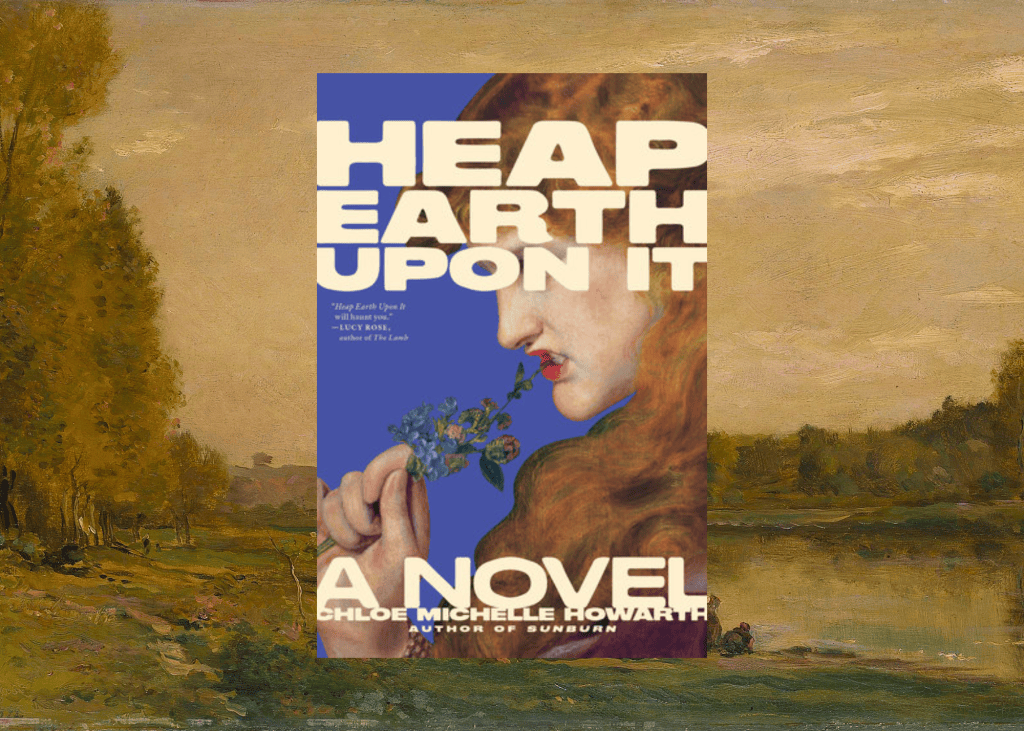
Heap Earth Upon It reminds readers of Howarth’s mastery with this creative skill. Released on February 3rd of this year in the U.S. and published by Melville House, the novel is still featured prominently on many indie bookstore shelves. This hybrid work of gothic historical fiction has a timeless quality to it that is rare to find in the popular subgenre of literary fiction commonly found in indie novels.
The story examines the four O’Leary siblings, who have recently moved to the rural village of Ballycrea, Ireland, in 1965. While attempting to forge a new life in an unfamiliar community, they are haunted by their mysterious past. Secrets begin to rise to the surface as the three eldest siblings, Tom, Jack, and Anna, navigate their own challenges and grow closer to their wealthy neighbors, Betty and Bill Nevan.
My initial reaction while reading Heap Earth Upon It was the acutely personal narrative. The O’Leary children address a “you” in their first-person narration, creating an air of familiarity in an already claustrophobic landscape. Obviously, the audience learns that they are referencing Lillian, Jack’s deceased partner who is at the heart of the family secret, but the narrative device immediately caught my attention nonetheless.
The significance of sibling relationships as creators of generational guilt and isolation is witnessed in the O’Learys, but also mirrored with Betty and her brothers. Her connection to them is both estrangement and mythology. Betty watched them leave Ireland and sail to America with the hopes of opportunity and growth, leaving her to reside in the past. Even though the O’Learys packed up their lives to move together, they are all existing at different moments on a timeline, some trapped in memory more than others. This is clear in the interactions between Jack and Tom, where Jack can’t help but cling to Lillian, and Tom wants to make connections and find opportunity in Ballycrea.
In line with the novel’s gothic style, the unknown as the inevitable is a prominent theme. When looking at the sibling relationships, it makes being haunted a reality that one must live in. America and death both fulfill this role as those who move or die are mourned and lost forever. I thought this was a clever utilization of the theme on Howarth’s end as a sort of subversion of the traditional gothic unknown to reflect the historical instances of families separated by immigration.
The narrative’s sapphic influence witnessed in the character of Anna draws parallels with Howarth’s debut novel, Sunburn. Specifically, it is the way sexuality and community interact. Ballycrea is tight-knit and suffocating, acting as a physical manifestation of Anna’s mind when navigating her feelings towards Betty. In Sunburn, we see a similar dynamic between the town of Crossmore and Lucy and Susannah’s relationship. But, in 1965 the language to describe Anna’s sexuality was nonexistent compared to the 1990s era of Sunburn, causing Anna to feel an even greater sense of isolation among the people and culture that surrounds her.
One of my favorite lines in Heap Earth Upon It is from Jack’s narration speaking to Lillian:
“Go on, pet. I might see you again.”
In my opinion, this is quintessential gothic diction. Jack telling a deceased person to “go on” reveals a great deal about his mind, and how haunting operates in the novel. Loss and personal identity become so intertwined for the O’Learys that the lines become blurred, and all they can do is exist with the memories as their present and future. Howarth utilizing a genre commonly associated with 18th-century literature somehow makes this historical narrative feel more modern. And, it’s this intersection of style and genre that makes the heart of indie storytelling.
Rating:
Image taken from Amazon

Leave a Reply