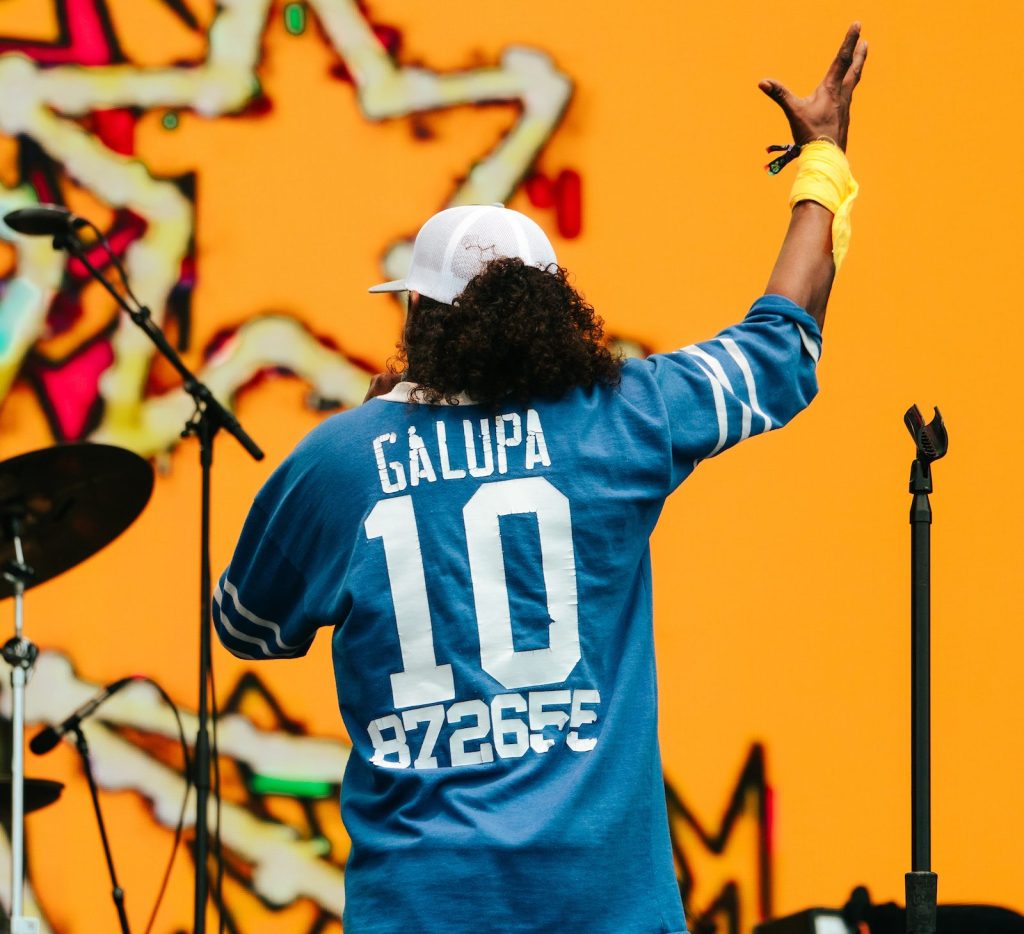
King Stingray is more than just an Australian rock band; they’re a tangible connection between home and elsewhere.
A five-piece comprised of Yolŋu (Aboriginal people of northeast Arnhem Land) and balanda (non-Indigenous) musicians, King Stingray mixes elements of rock and the ancient Indigenous tradition of manikay to make something that is uniquely their own (dubbed as Yolŋu surf rock). Currently, the band’s members are Roy Kellaway (guitarist), Dimathaya Burarrwanga (lead vocals), Campbell Messer (bassist), Lewis Stiles (drummer), and Ngalakan “Billy” Wanambi (didgeridoo, vocals, bilma).
Their songs consist of both English and Yolŋu Matha, making for a cocktail that is as familiar as it is unknown for listeners, but the meaning of which transcends language through the infectious melodies and beats that the band produces. And as said by lead singer Burarrwanga during their electric set at Sea.Hear.Now, “We just want people to feel happy.”
So first of all, you guys’ set was awesome. Super cool. How was your first impression of Asbury and New Jersey? You guys like it here?
Roy Kellaway: Yeah, we love it. We got here a couple of days ago, and we’ve just kind of been getting our bearings. It was great to see the water. It helps us find our bearings when we see the coast because we come from the coast. So yeah, it’s good to see the coastline, and yeah, we’re kind of just cruising.
Awesome. How is it different from Australia?
Kellaway: It’s so different.
Is it worse? You can be honest.
Kellaway: No, it’s just so different. Different weather. It is a very long way for us. It takes two or three days to get here. Because he (Wanambi) comes from a very remote place at the moment, living in Tiwi Islands. It’s an island off Australia; then he gets to Australia; then we get to fly to a city to then fly here, and it’s a long time. So that also adds to feeling like you’re in a foreign place.
So then, coming from Australia, how did it feel to play the main festival stage at Sea.Hear.Now today?
Kellaway: It was so cool. And it was great because when you travel a long way, you just want to be able to play your music in front of some people. It was awesome. The rain was making us a bit worried, ‘Oh, maybe people won’t rock up,’ but good turnout.
I feel like people in New Jersey are usually pretty resilient. I feel like they’re dedicated to the music, so they probably would have come if it was raining more.
Kellaway: There are lots of music lovers here, right?
Oh my gosh, yes. 100%. You guys mentioned the cold during your set; how are you guys faring now?
Wanambi: So back in our place, it’s warm there, humid. So at night time, it gets cold. And daytime, it gets real hot.
Kellaway: So this wind is making us cold.
You should have been here last year. Last year it was so hot. You guys would have been fine.
Kellaway: Does it snow here?
It does, yeah. We’ll get crazy snow in the winter, like December and January. It gets really cold.
Kellaway: We’re not even in the cold part!
No, this is like summer. So then do you guys feel like it’s important to sing in an uncommon language in a part of the world that doesn’t speak it? Why or why not?
Wanambi: I think it’s good for other people back home—our support back home, family, friends, others—and to bring it up here on another continent and share our culture and language.
Do you think people need to understand the language to be able to enjoy your music?
Kellaway: Music is a universal language, but we always have a bit of education with what we do. No one here speaks Yungmata, but even in Australia, it’s unique. Maybe only spoken by a few thousand people. It’s a very, very special, unique, and efficient language.
Wanambi: So I speak four, five different languages.
Kellaway: Like dialects?
Wanambi: Dialects.
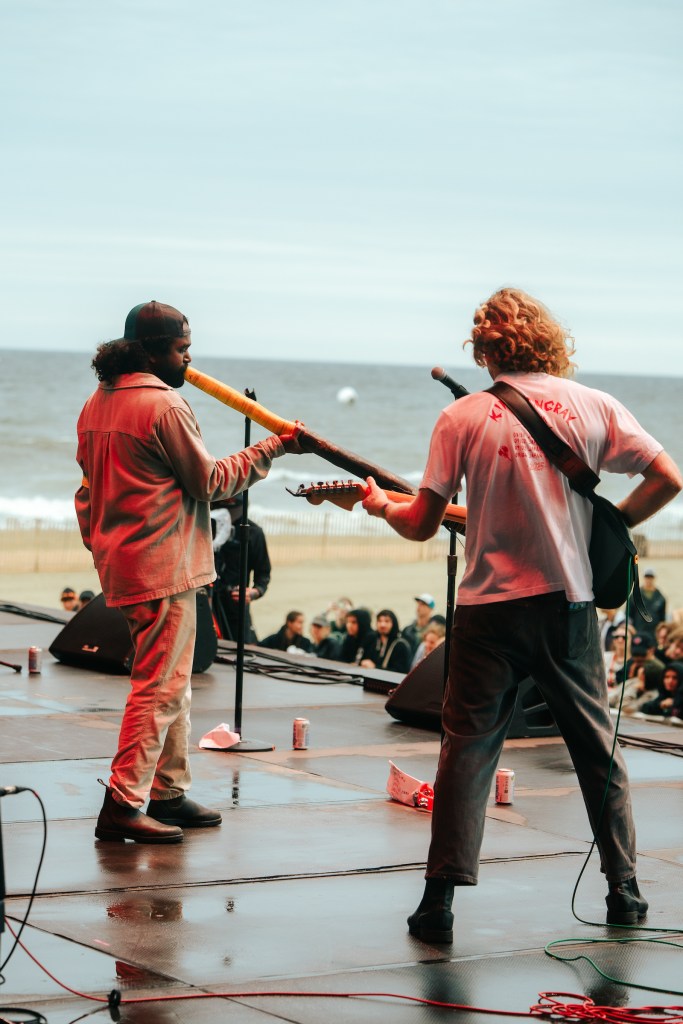
And then I feel like with our experience at the festival, we’ve never seen an artist play the didgeridoo. How does it feel to maybe be the first introduction of that instrument to an audience?
Wanambi: Pretty special. Special and good for the soul. Also, the circular breathing, it’s hard.
It looks hard.
Wanambi: Gotta blow in and out, and hope they liked it and felt the power.
Kellaway: We had a few people go, “What is that instrument?” Some people here have never even heard of it or don’t know what it is, and it comes from where Billy’s from. They trace it all the way back to that particular area.
At our magazine, we focus on up-and-coming artists, smaller artists. What advice would you give to artists who are hoping to one day play a stage like Sea.Hear.Now?
Kellaway: We’ve always been a touring band. We gig a lot, and this is our fourth or fifth time coming to the US. Getting it done, getting out on the road, playing your music, that’s where opportunities present themselves. If someone wants to eventually play a gig here, I guess you’ve just got to put yourself out there and do crazy things and try to get on the road. You spend a lot of money, you just go for it, you have fun, and see what happens.
Photos taken by and courtesy of Anna Downs | Interviewed on September 20, 2026

Leave a comment