
“It has always been my dream to publish a book of poetry,” said Srijani Mitra, a poet based in Bangalore, India. Now, with her debut collection, Mantras of the Moon, she can finally say it has come true.
Born and raised in Kolkata, India, Mitra has been a poet ever since she was a child. “I really felt that poetry was my safe space,” she said. She started writing in her mother tongue, then transitioned into English poetry. It was clear early on that she had the drive it takes to become a published poet; her work has been published in various literary magazines since she was 17.
Her fascination with poetry started in the classroom. She recounted, “One of my Bengali teachers was a great poet. I read one of her poems in a magazine of Bengali, and I was very inspired to write poetry after her.”
She also attributes the poet Tagore as an early inspiration. “Tagore was the greatest of inspirations because Tagore is somebody who was related to our lives as Bengalis in a great way,” she said. She continues to return to Tagore’s vast body of work, each time understanding the nuances and depth in a new way.
She went to university to study psychology. It was during this time in her life that many of the poems featured in Mantras of the Moon were written. She later decided to pursue a degree in English, but kept her fascination with psychological theories as a key element of her writing.
“I talk about emotional theories in one of the poems. I talk about the gestalt of memories in another. Gestalt is a psychological topic… I’ve been really fascinated by all of these theories, and I really wanted to make something creative out of what I’ve learned. And I learned a lot about myself through the process of writing,” she explained. “So it’s a lot of catharsis, I feel. I think understanding of self and psychology has given me inspiration to write the poems.”
Inspiration also struck in her study of English literature. She found a fascination with many contemporary poets and how they, too, often delve into psychology in their poetry.
When talking of the contemporary poets she loves, she said, “The anglophone poets, mostly of India, I think that they have inspired me a lot. Poets like Arundhathi Subramaniam and Meena Kandasamy. All of them. They have inspired me, and they also sometimes delve into psychology.”
Language is another incredibly important aspect of Mitra’s writing. The word choice in each of her poems feels incredibly conscious and unique. When writing her work, she is very careful about the words she chooses. Her decision to merge words from her mother tongue with her English poetry is one that came very naturally to her.
“I think there are a few words in Bengali, which I just cannot do without, because those come naturally to me whenever I’m writing a poem. So when I’m writing a poem, it’s always a very conscious choice of language. I know where to put the restraint, where to make the musicality come in, so I am consciously thinking about that somewhere. But at the same time,” she said, “subconsciously there are some words in Bengali, which come along when I’m writing, so I just put them out there on the paper. When I reread the poem, I feel that it fits in well within the context of the poem, so I keep it as it is.”
Not only does she like the way it reads, giving each poem a sense of authenticity in tune with her cultural background, but she also feels this choice gives other writers and readers something to learn about her language and her culture. She enjoys playing with how two cultures can come together and mingle naturally.
A key use of this exploration of the interconnectedness of cultures can be found in her poem, “Mermaid myths—Reconstructed,” where she imagines the many cultural variations of mermaid mythology, connecting it back to ideas found within Indian culture. Mitra said, “I kind of related mermaids to a kind of power which is closer to Kali or the Shakti that we talk about in India. So, I would say it’s the power of women that comes out when I talk about mermaids.”
She continued, “My heritage comes automatically into my poetry because that is how I have been born and brought up… I celebrate my Indianness in a way that reflects in my poetry.”
Mitra builds a strong sense of nostalgia in her poetry with golden imagery of her youth and the places she has traveled, found in poems like “Portrait of Adbhutam Bhava” and “Monsoon of Memories.” A large part of her inspiration for these poems was her travels as well as her upbringing. She dedicates her collection to her grandparents, saying, “They have been very integral in bringing me up, and they have been so supportive of my work; no matter who criticized me, they’ve loved me so much, and they’ve only supported my writing.”
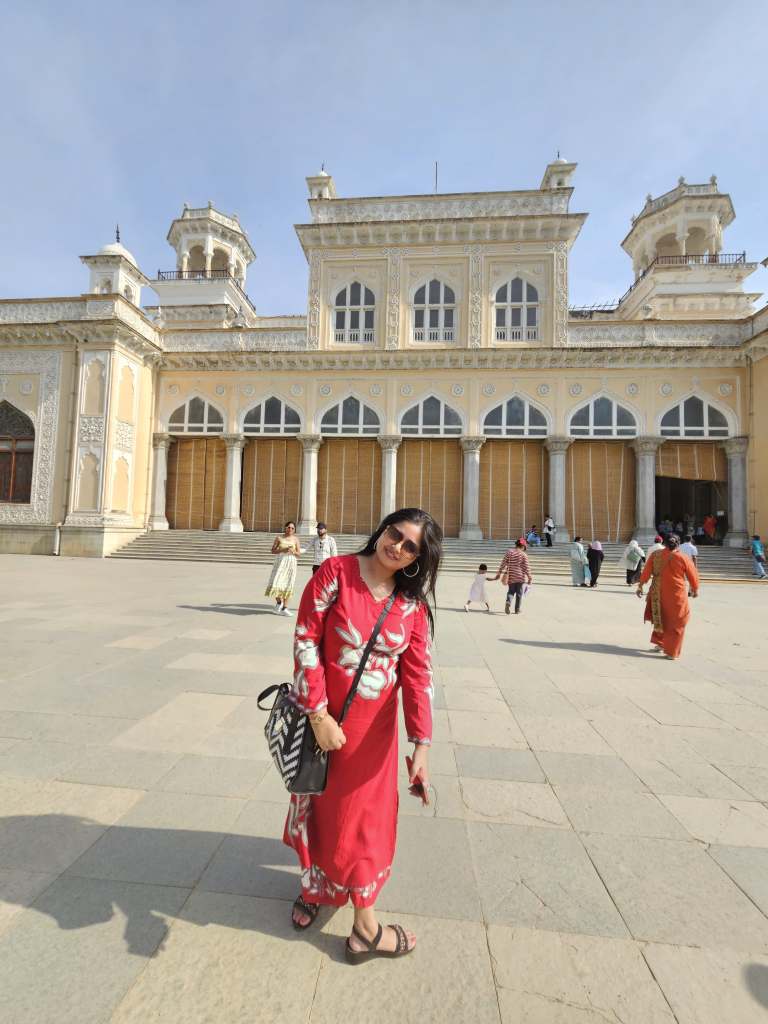
To write poetry is often a deeply personal and emotional experience. When it came time to curate the poetry included in Mantras of the Moon into a cohesive collection, Mitras said that she curated it with real care. She said, “I’m very grateful to the editors of Red Rook Press for reading it with such care and bringing up certain things that they found with it, and all the editorial process that goes into it. But when talking about the curation, I was very careful about the fact that I want more spiritual poems, I want more psychology poems, I want more poems which gave an understanding of myself and my culture.”
In her decision to title the poem Mantras of the Moon, she said, “The moon is very mystical, and it has always been a favorite of the poets. I think, in that way, my poems also sometimes become mystical; they are meditations on the self, on life, on emotions, on life, on places. So that is why the title came about, and I find it is quite a mysterious, musical, and emotional title.”
Now, as a poet with a published book of poetry, Mitra’s goal is to go out and share her work with as many readers as she can. On having her work published and out in the world, she said, “It feels amazing. It feels surreal, and it’s like a great opportunity.” She hopes readers can relate to her words, reflect on their lives, and get a sense of her own life. She hopes that readers can learn and connect to some element of her writing and is beyond excited to share her work with the world. “I want to reach out to as many readers as possible.”
Photos courtesy of Srijani Mitra | Interviewed on June 9, 2026

Leave a comment