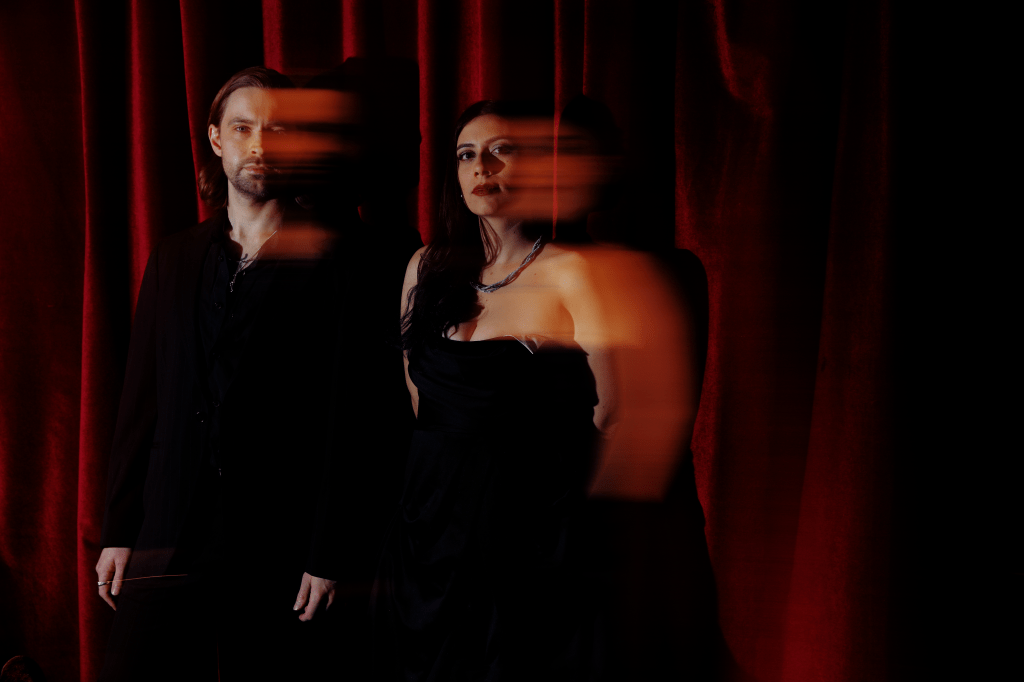
There’s something instantly intriguing about SYLVR (pronounced “silver”). This UK-Peruvian duo seems to have arrived fully formed, with a sound that feels less like a debut and more like recollecting your dream from a few nights ago.
Made up of Jamie Thomas and Raquel Bartra, SYLVR’s sound lives somewhere between goth-pop and electronic haze. It’s what they call “nightmare pop”—a phrase that makes perfect sense when you press play. Before I met them, I noted their tracks felt cinematic. When we sat down outside a London cafe to discuss their upcoming debut, I learned that was not only intentional but key to their formation.
“In hell,” Bartra jokes straight-faced, when asked where they met. Both were originally pursuing filmmaking and crossed paths on a career scheme. “It was very intense… we probably trauma-bonded.” What started as daily phone calls about surviving that world slowly became a creative partnership, with cinema the shared language.
As Thomas puts it, “Film’s been like a window through which we’ve come to the music, rather than the other way around.” Every track seems to unfold like a movie scene, with layered instrumentals and narrative lyrics prompting strong visuals of flickering projectors, grey skylines and abandoned roads.
That visual instinct runs through everything for them. SYLVR was born after a USA road trip in late 2024, where a hurricane-warning saw the pair wind up in the small town of Sylva, North Carolina. They fell for its eerie Halloween atmosphere, a gothic bar lined with taxidermy snakes (“Shout out to Chris!” at The Cut Cocktail Lounge), and the strange, silent beauty of the area. Although they didn’t record for another year, that town set the ambiance for their collaboration and the name stuck—albeit slightly altered.
Behind the scenes, these two might seem an unusual pairing for such an ethereal electronic
sound: a girl from Peru’s capital raised on Franco de Vita and Journey whilst drumming in the
school marching band and a lad from Birmingham who devoured Zepplin and Sabbath,
jamming with rockers from a young age. Yet, I can’t help but notice how aligned they are. They arrived separately, but each dressed fully in black with sunglasses and self-deprecating humour.
Throughout our interview they both offer a steady stream of phantasmagoric film
recommendations and nerd out over arrangements, often unconsciously finishing each other’s sentences. Hard to believe they’ve only just started recording together.
Their debut body of work centers around four tracks, all written by Thomas in late 2025 before Bartra added melodies and lyrics. The songs were recorded at The Louisiana in Bristol, co-produced, recorded and mixed by Alfie Tyson-Brown, then mastered by Shaun Joseph. Despite the polished product, the process was surprisingly chaotic. Bartra spent six weeks back in Peru while writing vocals, and much of the material came together remotely, using her dad’s podcast studio as a makeshift booth. After she returned, almost all final vocals were recorded in just one day at the end of January.
The first track they built together, “Beckoning,” feels like the emotional centre-piece of the
project. Thomas wrote the instrumental quickly, inspired by Arabic drone music, layering simple chords into something hypnotic. “I wanted it to have that kind of tripped-out, almost dubby feel, but with a real darkness to it,” Thomas explained.
Bartra’s lyrics pair perfectly, but took much longer. She describes them as a form of emotional release, shaped by personal heartbreak and an ongoing obsession with Dracula adaptations. The song plays like gothic theatre with lyrics, “If I beckon you, will it pull you in?” igniting a dance between promise and power. You can hear exactly what she means when she says she likes songs to have “a plot.” None of the four tracks end in the same headspace they started.
Then came “Grey One (La Gris).” This is a time capsule. Sung largely in Spanish, it revisits lyrics Bartra penned aged fourteen when living in Lima, a city nicknamed “the grey one.” The song captures a teenage urge to escape, but has been tweaked to include hindsight— acceptance replacing rejection: “Yo soy de Lima la gris.” It was important to adult Bartra that this not be a diss track for a hometown she now appreciates. It is repetitive in the best way: mantra-like and immersive.
“I knew I wanted to do something that had a club-y feel and was much more skewed, electronic, beat focused. […] I chopped it up a lot and wanted it to feel like it had been remixed,” Thomas explains. “Repetition is a huge thing in Peruvian traditional music too,” Barta adds, “like the marinera (a traditional dance).” The song’s bilingual approach opens a fascinating direction for the band’s future. We discussed how languages bring different rhythms and styles of singing, something they both enjoy playing with. “Spanish is also becoming, thankfully, quite big now. […] This is a good opportunity to go back to my roots,” Bartra concludes. “So, for the stuff we’re writing now, we’re definitely gonna have more in Spanish.”
Next, the duo wrote “Circle Seven,” the first single and probably the cleanest introduction to
SYLVR’s strange world. If “Beckoning” was the slow-burning descent, “Circle Seven” is the moment the protagonist smiles and walks willingly into the flames. Built around Dante’s seventh circle of hell, it transforms inferno imagery into something seductive. Thomas says it has “an instantaneous draw,” while Bartra describes it as “very cathartic.”
“It’s about going on your own journey, even if that means going to hell, but not necessarily as a bad thing […] just as an investigative thing. What do you do in a situation where you could be damned, but you actually make the most of it?” she muses.
The track originally had completely different lyrics—“lighter, more of an adventure tune,” Thomas laughs—until the pair rewrote the chorus around the inferno concept, pulling the whole song into darker territory. It works brilliantly: pulsing, dramatic and weirdly euphoric, like driving through a city at 2am.
But why make this one the single?
“It’s just a good entrance, isn’t it?” Thomas grins into his coffee cup.
“And the truest exhibit of nightmare pop,” Bartra finishes.
“The Blasts” shifts gears completely. It’s the final track they wrote and the shortest, maybe the most vividly imagined. It’s impossible not to groove to. A frustrated Bartra told Thomas she wanted to make an anti-war anthem and wrote the lyrics in a day. The concept? A non-violent, immortal, vampire projectionist, watching wars unfold on screen. Originally a film idea of Thomas’, the song’s use of sparse lyrics and textured instrumentals creates something genuinely moving within the absurd.
Musically, it also came together fast. Thomas had just returned from Tangier, inspired by hearing live Anatolian folk music played intimately in someone’s front room. That atmosphere bleeds into the track: old-world drones colliding with electronic beats, like history itself crackling through static. “I wanted it to have that contrast between feeling ancient but using modern sounds,” he says.
SYLVR may be only just starting out, but artistically they have a cosmos behind them. Each track is a fragment of a larger world stitched together. “They all exist in the same place, in the same universe,” Bartra reveals. “Characters just walking in the streets of the same world that has red skies.”
I wonder aloud if these screen fans have any music video plans. “I’d love that!” Thomas exclaims, sitting up. Rather than “outright” videos though, they’re toying with an idea “of alternative versions of the tracks, filming them, performing them live in an interesting way. Grounded by that kind of language of cinema.”
Performance has repeatedly crept into this conversation. Aiming to present a live set in
autumn, the duo have considered it in more detail than most electronic artists I’ve met. “It
obviously hasn’t started as a live thing,” Thomas nods to the fact they only spent a couple of
days recording in the same country. “We’re very conscious of the execution of it live, bearing in mind there’s only two of us, and I want to keep it that way.”
Despite that distance, he says they both were “always thinking of what it looks like live, how it feels, where it could be.”
Bartra is quick to agree. “We would like people to feel very immersed, very into the world,” she says.
Thomas continues, “All the directors that we love, even though their films might be wildly different from one another, you instantly have that familiarity, that feeling and experience of watching them—that’s something that we are striving for with this.”
So what can we expect in the live set? While those core tracks will certainly feature, the pair
are continuously writing and tight-lipped on details. “It’s about finding a way that does it justice and is interesting to watch, but also something that expands the experience of just listening to the digital tracks,” Thomas explains. “I’ve seen far too many examples recently of bands that play shows, and it’s just like—”
“—like a karaoke set,” Bartra joins.
“Exactly,” he agrees. “Particularly with—”
“—with electronic music.”
“So we’re just trying to think of how we can make that worthwhile as an experience,” Thomas concludes.
“Ideas are percolating,” Bartra teases.
These two have nothing to worry about when it comes to performing together; they’re clearly already in sync. With SYLVR’s debut single “Circle Seven” having landed on May 22 across all streaming platforms and Bandcamp, listeners can officially receive the first transmission from the band’s shadowy, red-skied world.
Photos courtesy of SYLVR, taken by Joe Tutt | Interviewed on May 9, 2026

Leave a comment