“I think that I view the page as a playground,” Kay E. Bancroft said, describing their writing style. “And what I mean by that is I seek to understand what the limitations of the page are.”
This writing approach has sustained Bancroft’s work since they embarked on their MFA in creative writing with a poetry focus at Randolph College, from 2020 to 2022.
“My MFA shaped my willingness to be bold, and I say this because Randolph is such an incredible, supportive, beautiful space, truly. I don’t think that I would be the writer that I am today without the creativity and support of the entire community from that program,” Bancroft explained.
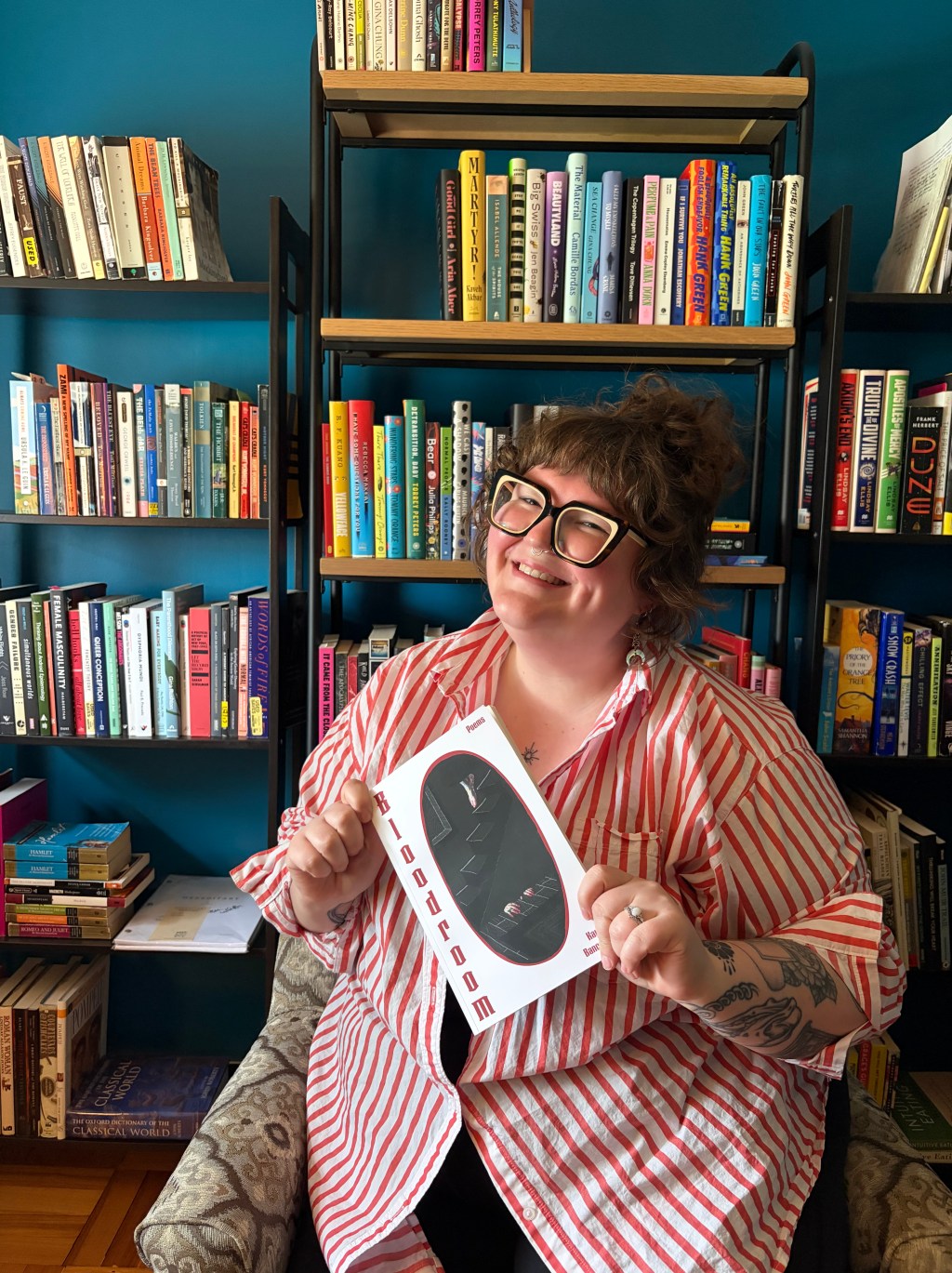
That encouraging environment has been formative in Bancroft’s literary journey, helping them seriously conceptualize what is now their debut poetry collection, Bloodroom, released by Sundress Publications on June 9.
Described by readers as “part museum exhibit” and “brim with glimmering sorrows,” Bloodroom is a hybrid exploration of intergenerational relationships through a pop horror lens. It delves into what one inherits from those who came before them and the effects these elders have on both the individual and future generations.
Thematically, the book explores identity, queerness, the body, and nature through various styles and forms that Bancroft experiments with.
“That’s one thing I love bringing into my work, is a lot of formal play and a lot of variants in the structure,” Bancroft remarked. “There’s a burning haibun in there. There’s a poem that’s after Camonghne Felix. … There are a lot of different formal choices that I made that really work with the content of the book.”
There are multiple series included in the collection that are used to illustrate these ideas visually, one of which is called the Lexicon series. This consists of poems that are direct erasures of dictionary definitions, working to interrogate familial debt and what it means to have obligations toward one’s family.
Another series is based on a military ID application that Bancroft’s grandma once filled out. While devoid of any personal information, their grandmother’s fingerprints remain and are, at times, used as section markers.
“This series of poems is very, very prominent in the collection,” Bancroft noted. “There’s a lot of play with space and adding and removing content within these very structured cells within this application. And a lot of them really delve into identity and, you know, presence and absence. So, I think that readers will be surprised how they weave throughout the narrative of the collection.”
These deep ruminations and personal investigations give Bloodroom an incredibly introspective tone, reflecting Bancroft’s voice and desire to evoke intense emotion.
“There’s a lot of grief and also a lot of, I think, reverence for oneself and also one’s past, but also kind of hope for the future of the speaker, which I think is really integral to the collection,” Bancroft asserted. “It’s just very visceral in a way that you can feel yourself being surrounded in the poems, feeling it very deeply, which I think is part of my style—to really entrench the reader in the space that the speaker is in.”
The pop horror lens became a vessel for Bancroft’s writing and storytelling because of horror’s emotional complexity and representation of challenging family dynamics. This allowed Bancroft to explore complicated relationships through the language and ideas portrayed in accessible and beloved forms of media.
“I feel like the trope of the final girl really lends itself to an identity for one, but then also the idea of being someone who carries on a legacy,” Bancroft reckoned. “All of the final girls have their own ‘legacy’ and their own traumas that they bear. And so in that way, I felt like the work I was writing was really emulating that.”
“This collection really leans into that kind of understanding of intergenerational relationships through the matriline and talking about, well, what does it mean to be a daughter, or a child of someone? Hereditary really struck a chord for me in that way,” Bancroft continued.
Bloodroom’s publication is the culmination of three years of submitting to various publishers. Bancroft initially started writing these poems before they began grad school, but after exploring a lot of visual work with a mentor at Randolph, especially tinkering with documents received from their maternal grandfather, a through line began to form.
After their manuscript was accepted by Sundress, Bancroft worked with a dedicated editor on several rounds of edits to first address the order and flow of the poems, followed by talks of line edits, adding and removing poems, and finally, formatting ideas such as font and layout.
Bancroft credits the small but dedicated team to helping mold the collection to be one that they believe will resonate with readers.
“Working with the smaller team is really nice because you do get that one on one. I can talk with the editor kind of whenever I have a question, so that was really wonderful,” Bancroft resounded. “The editors … asked really wonderful questions and really pushed me in the direction that I think that the collection needed to go in. And that’s why I feel like the final result is so impactful and I’m really just grateful for that.”
More specifically, Bancroft hopes Bloodroom inspires readers to reflect and consider their own needs and expectations in relationships.
“I hope that it allows them to question difficult relationships in their life and make decisions and changes and have really deep conversations with themselves about what they’re willing to and not willing to accept in their every day, whether that’s just truly for themselves or in relationships that they have with their family or otherwise,” Bancroft expressed.
Bancroft, who obtained their bachelor’s degree in professional writing and a certificate of marketing and creative writing from the University of Cincinnati, realized they wanted to write back in high school.
“I just really loved learning about writing and the way that people told stories, and my freshman English teacher … really made me realize that writing is fun and that reading and writing are just so life changing, and so then I was like, ‘Oh, I think I’m going to get really into this,” Bancroft recalled with a laugh. “Being a writer is the best thing that ever happened to me when I was younger, because it gave me a way to be creative and just feel like myself.”
Following a busy summer full of tour events, Bancroft says they “want to write everything”: a short story collection, a novel, and of course, a second book of poetry, which is already underway.
Exploring the boundaries of their writing, alongside being an active community member and literary citizen, is their ultimate goal, and Bloodroom is just the beginning.
“I think sometimes people are afraid to take chances on the page, take risks, like break what people think is normal and ‘acceptable,’ and I think we need to be less acceptable and more willing to lean into our strangeness,” Bancroft said. “I just want to keep doing weird work with people that I love and care about.”
Photo courtesy of Kay E. Bancroft / Interviewed on June 2, 2026

Leave a comment