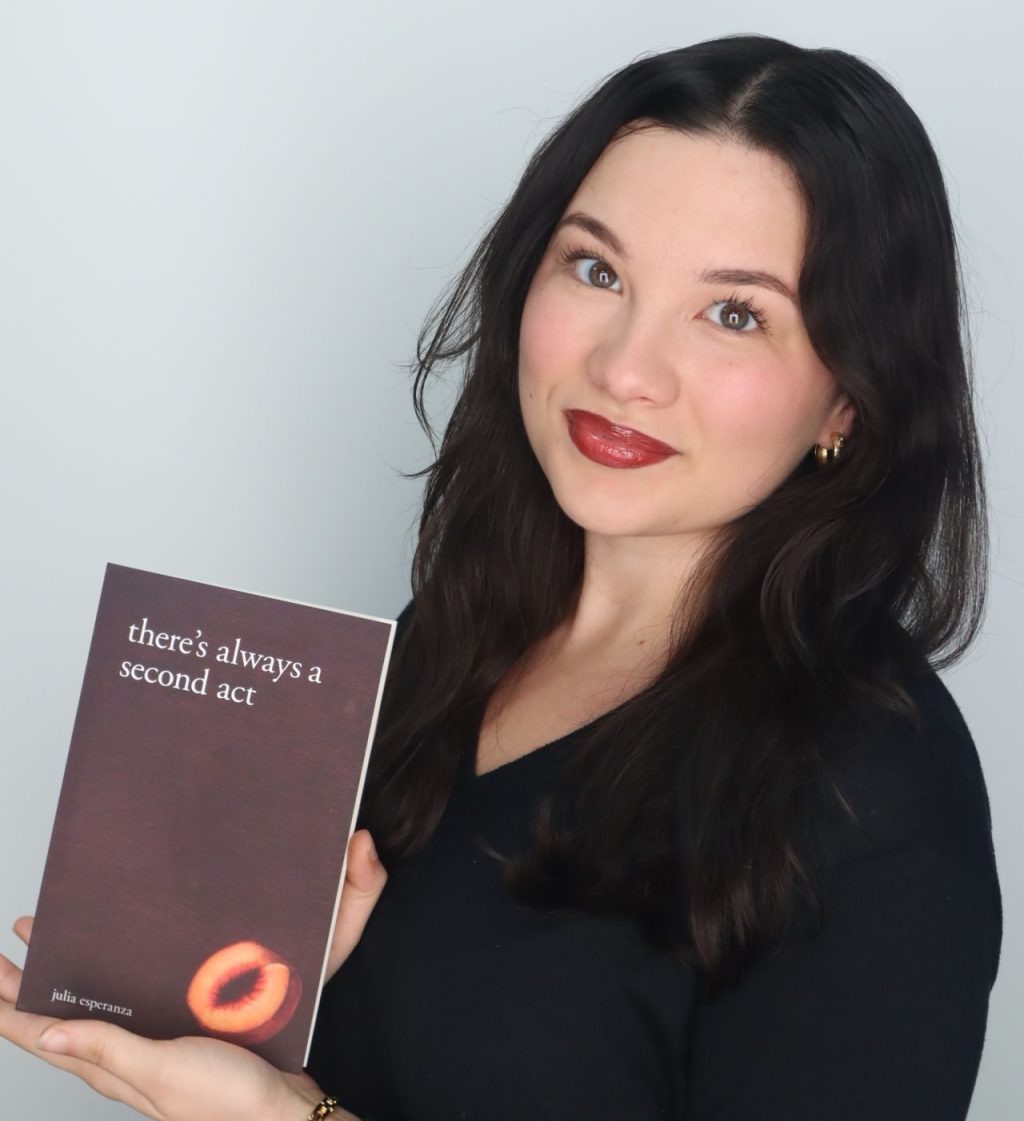
“I didn’t know that I wanted to be a writer,” Julia Esperanza admitted with a smile. “If anything, I tried my hardest to avoid it.”
Born and raised in South Florida, Esperanza grew up writing stories to go along with the pages in her coloring books, letting her imagination run wild with ideas. As she started having more adolescent experiences, she turned to writing poetry—in her journal, the notes app, anywhere she could put her thoughts down to process different emotions.
Despite a clear affinity for the craft, for a long time, Esperanza didn’t entertain writing as a serious path, feeling as though it wasn’t feasible or only meant for people who were already published.
“I was so in denial that I wanted to be in the humanities,” Esperanza, a current graduate student of literature at Texas State University, said. “I was convinced that I had to be in STEM to make a living … I remember being in my senior year [of high school], and we were coming across college app[lications], and I waited until the very last day to apply for an English program.”
It was that decision to finally lean into her love of writing that ultimately led to Esperanza’s debut poetry collection, There’s Always A Second Act. Released by Indie Earth Publishing on March 24, it’s been described by readers as “the poetry your soul needs to hear, see, touch, taste.”
Organized into two acts, the collection explores themes of growing up, loss, forgiveness, self-love, healing, family relationships, and identity.
Act I is characterized by poems with complex emotions like guilt and anger, many of which are inspired by Esperanza’s experiences. The tone of Act II is more complicated: still a bit melancholic, but emphasizing that feeling and how unpacking heavy emotions is a nonlinear process.
“[Healing is] this act of choosing yourself, and sometimes that’s heavy. Sometimes it’s hard to do that,” Esperanza said. “There are a lot of poems in the second act that are just about family and loving yourself and making this home for yourself, or being in a healthy relationship—all these things that are so different than Act I.”
The second act also shines a spotlight on the Chicana poet’s cultural identity and upbringing.
“Family is a really big, important part of my life and my culture. They’re the reason why I understand things the way that I do,” Esperanza explained. “By writing about these things and purposely including certain elements of my culture into my work, it feels like I’m paying homage to my culture … It’s very personal for me.”
As a whole, constructing the manuscript was a process driven by brutal honesty and self-reflection. Esperanza took inspiration from the works of Ire’ne Lara Silva and Sandra Cisneros’s Woman Without Shame, which she says made her feel comfortable with being raw and authentic in her writing.
“Being honest about my experiences was the hardest thing for me. Me being so close with my family, I’m like, ‘Oh my gosh, what if they feel like I’m dissing them or something?’” Esperanza said. “[But] if my poetry is a way for me to process things, then I have to be honest, otherwise, it’s not gonna do what it’s meant to do.”
“I think when it came down to it, I would reread certain poems, and I’m like, ‘Okay, you’re not saying this in the full way, you’re not being completely honest. You’re trying to still hold certain things back,’” Esperanza continued.
Titling the collection was also initially a difficult task, but it ended up being a crucial step that paved the way for the rest of the writing and assembly of the book. Esperanza found inspiration in a quote from F. Scott Fitzgerald’s The Last Tycoon: “There are no second acts in American lives.”
“I actually don’t agree with that [quote]. I think that we can continue to choose to heal, to choose to forgive ourselves, to forgive others,” Esperanza said. “I think life has its things that happen, and we’re gonna keep going through act one and act two through the rest of our lives.”
When it came to editing, Esperanza did what many writers do: printed out copies of her work. As an English major who loves to annotate, it only made sense for her to read her poems out loud and make notes along the way to add punchier or more direct language wherever necessary.
Many poets and readers alike agree that hearing poems read aloud is crucial to understanding them, and this heavily informs Esperanza’s style.
“A big part of that process was sitting on my balcony outside and seeing how these things flow off the tongue and how they just sound. Sound is a very big part, especially since I purposely write my poetry with a lot of grammar,” Esperanza said. “It’s because I think of that musicality. I think punctuation really adds to the flow, and it lets you know where to pause and stop or emphasize something.”
The year-and-a-half-long journey to publishing There’s Always A Second Act began after Esperanza met Indie Earth founder Flor Ana on an online forum for Latina writers. During her senior year at Florida Gulf Coast University in fall 2023, Esperanza volunteered to be a beta reader for Ana’s debut novel, and after discovering Ana’s work with Indie Earth, she reached out to learn more about the publishing process.
“[Ana] was like, ‘Just send me some samples of your work if that’s something you want to do,’” Esperanza said. “So then I was staring at my computer for hours, just trying to decide on a few poems to send over. So, similar to the college apps, I did it on a whim, and then I let my computer be.”
The following semester, the contract was signed. Although she would love to be traditionally published someday, Esperanza says indie publishing was more accessible, approachable, and allowed her more creative freedom. She hopes other writers, especially students like herself, might consider going this route.
Next month, the M.A. student will graduate from Texas State, where her research has focused on adolescent perspectives in Mexican-American literature. Her ultimate goal is to obtain a Ph.D. in literature with the same broad focus and teach at the university level.
Over the next year, Esperanza plans to secure more publications in literary magazines and return to her short story drafts from undergrad, then later hopefully write her debut novel and a sophomore poetry collection.
Being published at just 21 years old is an accomplishment in and of itself, but what’s more important, Esperanza says, is having a lasting impact on readers’ lives.
“The most rewarding part is the people who have read my work,” Esperanza said. “They’ve started telling me, ‘Wow, I didn’t know this was something I needed,’ or ‘Yeah, this is something that I felt, too, you just put words to it.’ And I’m like, okay, so that’s what I do it for, you know? It’s no longer about me.”
Photo courtesy of Julia Esperanza | Interviewed on April 16, 2026


Leave a comment