Most people can articulate the significant events of their lives: graduations, weddings, funerals, birthdays. Those usually stand out.
But much of our humanity is captured equally, and for some even more so, in the seemingly small experiences that make up our day-to-day lives.
“Sometimes it’s not about the insanely dramatic [moments]—the tragedies and the comedies and the romance. Sometimes it’s just about everyday life and the different aspects that go into it,” Sophia Considine explained passionately.
This singular concept is the driving force behind Considine’s online publication, the little things: literary magazine.
After working on three lit mags as an English and creative writing major at the University of Iowa, Considine decided to create her own last June. The founder and EIC zeroed in on the niche topic after reflecting on a gratitude poem, “To Cold Cut Sandwiches” by James Transue, that was published in Issue 44 of earthwords, UIowa’s undergraduate publication. Once the focus was clear, she wasted no time getting the logistics in order.
“So, my initial [process of] getting everything set up for the magazine took me a day. I had started putting it together at like 3 p.m. or so on that Saturday and then finished at like 2 a.m,” Considine recalled with a hearty laugh. “I didn’t get up from my chair and just stayed there, didn’t eat. I finished … and I was like, ‘Wow, I’m starving.’”
Submission requirements for the magazine, which Considine envisions having two to three issues per year, state that it seeks previously unpublished works of poetry, fiction, nonfiction, and experimental writing. Considine defines the overall aesthetic of the magazine as being simple and carefree.
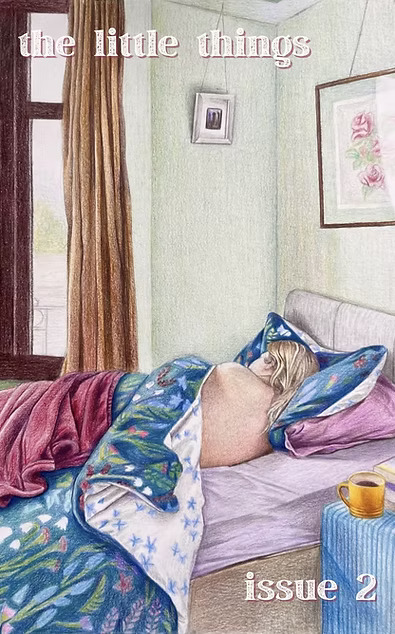
Of the many pieces published by TLT so far, a short story called “A Game Not to Lose” by Elizabeth Katherine was a standout in Issue 2 because of the way it addressed the magazine’s themes with a science fiction backdrop.
“[The story is] set in a video game, and it’s playing with the concept of time … and it’s just so intriguing,” Considine gushed. “It’s just so intense and really gives you that sense of longing that [the characters] have for their life while also feeling trapped.”
Additionally, Considine says this story is a model of how writers can still explore everyday concepts in different genres.
“If you’re gonna submit a fantasy work, it needs to still highlight the ups and downs of one or two characters’ everyday lives. It’s not going to be a full arc or plot. … I don’t want to see the full quest for something,” Considine clarified. “I want to see one moment in time for your main character or a side character or someone and see what their relationships are like, what is driving them, what this singular moment in time is doing for them.”
Surprised yet delighted by the interest and response TLT was getting online, Considine realized soon after the first issue that she would need to hire other dedicated publishing hopefuls to grow the magazine.
“[Issue 1] was a lot of reading for me to do and feedback to give to authors, but it was really awesome,” Considine said. “I was really proud of how much I was able to do on my own. I was, you know, posting regularly on social media and answering emails and actually putting together the magazine on Canva. I was really proud of myself for being able to do that by myself, but … [the] next step was understanding that it was getting too big for me to be doing this on my own.”
Now, with five acquisitions editors, two content creators, a social media manager, and an interior designer by her side, Considine has removed herself from and anonymized the submission process, putting selections solely in the hands of the editors.
Acquisitions Editor Andrea Ortega is early in her publishing career and applied after connecting with Considine and discovering TLT on LinkedIn.
“When [Considine] started [the little things], I was like, ‘Oh, I have to apply to this.’ I liked the whole theme. … I liked the concept of romanticizing life, so that’s why I applied, and then I was very happy when, after my interview, I got the role,” Ortega said.
There have been a lot of poetry submissions previously, and while Ortega would like to see a balance of more fiction and experimental work, she suggests that all writers remain authentic regardless of genre or topic.
“Write about what you like. … Go for what interests you and not what you think would interest other people,” Ortega advises future submitters. “I like [pieces] that really give me something to chew on.”
In a landscape where there is a wide variety of lit mags, Considine believes the little things stands out because of the effort the team puts into their feedback.
“We do get feedback to every writer, and I think that’s really important, especially in this day and age where I feel like a lot of people are … not knowing where they stand, or what they can do to improve, or what happened between them putting their heart out on the line and not making it,” Considine remarked. “So, I think the feedback aspect is something that definitely sets us apart from other magazines.”
Community building has also been a priority for the publication. Followers on social media can often participate in story chains and writing contests in the comment sections of Instagram and LinkedIn. There have even been virtual launch parties for each issue where writers and artists have read excerpts of and discussed their work.
With Issue 3 writing submissions now closed, TLT is accepting original artwork entries for the cover contest until June 5, and the anticipated launch date is set for the end of the month.
The EIC hopes to add a blog to the website sometime this year that highlights both relevant staff pieces and those of finalists who weren’t selected for publication. In the long term, her dream would be to collaborate with other lit mags and finance printed copies of future issues.
For now, the team at the little things cherishes the impacts it makes in the personal and creative lives of its readers and featured writers.
“I think that it’s important for both new and [emerging] writers and also older writers who maybe haven’t had anything traditionally published, or haven’t self-published anything in a long time,” Considine affirmed. “This is a great spot for them to really get feedback and have another community that they haven’t had in a while. … I want them to feel at home.”
Featured artwork by Helen Barber | Interviewed on May 6, 2026, and May 13, 2026

Leave a Reply